My kid was awful today. She got more upset when I mentioned she had a bad day at kindergarten too. "No, I didn't!" she screamed at me. "Yes, you did," I answered, "and I'm not going to pretend it was good when it wasn't."
One of the peculiarities of my church is an aversion to any references to blood sacrifice, or much of anything to do with the crucifixion. The latest objection was to the line "I have been set free / by the Word who lived and died for me" from Sojourn Music's really fantastic song We Are Listening.
Penal Subsitutionary Atonement was the understanding of the crucifixion I was taught growing up, and it continues to have it's ardent defenders. But it's philosophically and theologically problematic. I think the first time I heard an alternative perspective articulated was at Rob Bell's "The God's Aren't Angry" tour--this was before the brouhaha about Bell's possible universalism in "Love Wins," so the audience was pretty Evangelical, and they ate it up. Bell essentially presented a kind of Redemptive Hermaneutic, presenting the notion that blood sacrifice never originated with God, but was a human/pagan attempt to appease the God's who seemed so indifferent, arbitrary and cruel (as this world certainly seems). The Levitical sacrifices were limits on sacrificial means of atonement, and by becoming a blood sacrifice himself, God takes on the sin of the world by becoming--by taking on--the very kind of atonement God sought to limit in Leviticus. God takes on even our sin-filled, blood-filled attempts to atone for our sins, and in doing so, frees us from ever having to wonder if God loves us, if we must appease him more.
C.S. Lewis takes a parallel approach, articulating well the philosophical/theological problems with penal substitutionary atonement, arguing that in the crucifixion, God walks the path of dying to the old self, and so offers us a path (and the power) to do that ourselves. (Here is the full passage)
In the Orthodox view, the cross means this: Not even in death can we run from God--he joins us even if we decide to make our alliance with the grave. "The Orthodox understand the Cross as the ultimate proof and demonstration of God's completely sacrificial, forgiving and all-victorious love that is necessary in a fallen world—not because God had to have an (alternate) Victim for His wrath, but because, in a fallen world, this is the only thing that could reveal and convince fallen and sin-blinded human beings of the quality, extent and the limitlessness of God's love for us (i.e., ignite saving faith). This love alone is the grace that has the power in itself to transform us from the inside out into the image of Christ, which is God's will (both from an Orthodox and a Protestant perspective)." (Quoting "Karen" from a lively discussion on PARSE)
Now, what does this all have to do with my daughter?
Well, it's quite one thing to say that God must have been doing something else on the cross besides satisfying his own bloodlust. But it's quite another to avoid the crucifixion altogether, as if it was an accident of history that God endured, but not one that God used, in some manner, to show us the depth of his love in which we have a hard time believing and to save us from the spiritual death to which we are so easily drawn.
To ignore the atonement on the cross would be the same as me telling my daughter she had a fine day at school, when she did not. The cross must mean something more than a case study in injustice and corrupt political power. The cross IS ugly, brutal. So is this world. So is the process of dying to the old self. So, sometimes, is my kid's behavior. But resurrection will happen on the other side of it.
Showing posts with label Atonement. Show all posts
Showing posts with label Atonement. Show all posts
Thursday, September 18, 2014


Friday, April 22, 2011
What would have been Good Friday, 2011
I've recently stepped away from a church that was my home for the last two and half years. This being a public blog, and the reasons for my departure having interpersonal dynamics, I don't feel like it's appropriate to go into details here, or now.
It goes against everything in me not to explain myself. I hate being misunderstood, and I have felt that sting too many times. It is one of the worst feelings, to think you are being judged, not for things you have done (that's no fun, either), but for misperceptions. I want to justify my leaving. I want to be validated.
Jesus' death on the cross challenges me not to do so.
This, actually, would have been the central thrust of the Good Friday service I had been planning, before my departure: if we follow in the footsteps of Christ, if we take his salvation, then we are justified solely by his death. There is no room for self-justification if we accept his--this is what taking up our cross means: putting to death the self we tried to defend against all attacks, and standing only on Grace for our worth.
That gathering never took final form, but I thought I would share the reflections that were to have shaped it:
"The Woman gave it to me, and I ate"
"The serpent decieved me"
"When Pilate saw that he was getting nowhere, but that instead an uproar was starting, he took water and washed his hands in front of the crowd. 'I am innocent of this man’s blood,' he said. 'It is your responsibility!'
The desire to defend and justify ourselves is as old as time. Adam and Eve, the archtypes of our fallen nature, do this immediately upon being confronted with their guilt: Don't blame me! It's someone else's fault! Pilate (in vain, of course) seeks to absolve himself, to find some measure of personal peace in telling himself that executing a man he believes to be innocent is the responsibility of the Jews.
The more I am aware of this bent of human nature, the more I realize how destructive it is. At every turn, we are confronted with attacks to our dignity, challenges to our worth. "This is your chance to show how committed you are to the success of this company." "It was your job to take the garbage out." "For what you spend on lattes, you could feed starving children in Honduras." In all areas of life, we could be doing more: we could improve ourselves or our situation or our world; to deny this would be the height of hubris.
I know I myself am constantly trying to outrun the doubts about my adequacy. The whole world is trying to prove itself, all of us trying to build a legacy, have something to show for ourselves and our efforts. We are trying to justify ourselves.
At the cross, however, we are justified by God, through Jesus' death. The price of our inadequacy is no longer ours to bear, but God's to bear and to banish. What does it mean to be justified in Christ? Certainly it means we don’t have to carry the weight of our sin any more--the perfect One has forgiven our imperfection. But it is more than that: it means we are no longer trying to show the world that we are a good person, worthy of love. Christ died for us while we were yet sinners.
So we no longer have to carry the weight of righteousness either. Our worth is not determined by an adding up of the good and subtracting the bad, for as Jesus death shows us, God does not value us that way. We are beloved, worthy of the costliest of rescues, the death of the only Son, not because of our righteousness, but in the middle of our inadquacy.
If we crucify ourselves with Christ, we no longer have an independent self to defend. We no longer have to prove ourselves. Being a Christian is not trying to be a good person--the death of Jesus proves that being good enough is impossible for us--he died for all of us. We put to death the whole mess of trying to be good and failing. We put to death the losing game of failing to love others as much as we ought, as much as we want.
My temptation is always to self-justify, always to defend my honor. The world, the accuser, is always on the attack, always saying, “it depends on you, and you will fail.” If you do not love your kids, they will grow up to be miscreants. If you make a mistake at your job, you will be fired, passed over for a promotion, be stuck in a dead-end. You must measure up.
The cross says this: the measure was impossible for you, but it has already been met. If you accept the grace of the cross, there is no more measure to measure up to. God has covered it all. So do not only put to death your sins, put to death also your righteousness. If you accept the validity and worth God gives you, your righteousness is an outflow from him, a sign of his grace in you, not an insufficient effort on your part.
Here are my rights
Here are my deeds
I'm only made righteous
By the wounds where he bleeds,
The wounds of my God, who is gracious, so gracious to me.
So my prayer for myself, this Good Friday, is that God would take this, my desire to be understood and affirmed. Take this, the ache of separation and broken trust. Take this, the need to have been right in every decision I have made. These are my own attempts at righteousness. I lay them down, and again declare that I live under Grace. Amen.
It goes against everything in me not to explain myself. I hate being misunderstood, and I have felt that sting too many times. It is one of the worst feelings, to think you are being judged, not for things you have done (that's no fun, either), but for misperceptions. I want to justify my leaving. I want to be validated.
Jesus' death on the cross challenges me not to do so.
This, actually, would have been the central thrust of the Good Friday service I had been planning, before my departure: if we follow in the footsteps of Christ, if we take his salvation, then we are justified solely by his death. There is no room for self-justification if we accept his--this is what taking up our cross means: putting to death the self we tried to defend against all attacks, and standing only on Grace for our worth.
That gathering never took final form, but I thought I would share the reflections that were to have shaped it:
"The Woman gave it to me, and I ate"
"The serpent decieved me"
"When Pilate saw that he was getting nowhere, but that instead an uproar was starting, he took water and washed his hands in front of the crowd. 'I am innocent of this man’s blood,' he said. 'It is your responsibility!'
The desire to defend and justify ourselves is as old as time. Adam and Eve, the archtypes of our fallen nature, do this immediately upon being confronted with their guilt: Don't blame me! It's someone else's fault! Pilate (in vain, of course) seeks to absolve himself, to find some measure of personal peace in telling himself that executing a man he believes to be innocent is the responsibility of the Jews.
The more I am aware of this bent of human nature, the more I realize how destructive it is. At every turn, we are confronted with attacks to our dignity, challenges to our worth. "This is your chance to show how committed you are to the success of this company." "It was your job to take the garbage out." "For what you spend on lattes, you could feed starving children in Honduras." In all areas of life, we could be doing more: we could improve ourselves or our situation or our world; to deny this would be the height of hubris.
I know I myself am constantly trying to outrun the doubts about my adequacy. The whole world is trying to prove itself, all of us trying to build a legacy, have something to show for ourselves and our efforts. We are trying to justify ourselves.
At the cross, however, we are justified by God, through Jesus' death. The price of our inadequacy is no longer ours to bear, but God's to bear and to banish. What does it mean to be justified in Christ? Certainly it means we don’t have to carry the weight of our sin any more--the perfect One has forgiven our imperfection. But it is more than that: it means we are no longer trying to show the world that we are a good person, worthy of love. Christ died for us while we were yet sinners.
So we no longer have to carry the weight of righteousness either. Our worth is not determined by an adding up of the good and subtracting the bad, for as Jesus death shows us, God does not value us that way. We are beloved, worthy of the costliest of rescues, the death of the only Son, not because of our righteousness, but in the middle of our inadquacy.
If we crucify ourselves with Christ, we no longer have an independent self to defend. We no longer have to prove ourselves. Being a Christian is not trying to be a good person--the death of Jesus proves that being good enough is impossible for us--he died for all of us. We put to death the whole mess of trying to be good and failing. We put to death the losing game of failing to love others as much as we ought, as much as we want.
My temptation is always to self-justify, always to defend my honor. The world, the accuser, is always on the attack, always saying, “it depends on you, and you will fail.” If you do not love your kids, they will grow up to be miscreants. If you make a mistake at your job, you will be fired, passed over for a promotion, be stuck in a dead-end. You must measure up.
The cross says this: the measure was impossible for you, but it has already been met. If you accept the grace of the cross, there is no more measure to measure up to. God has covered it all. So do not only put to death your sins, put to death also your righteousness. If you accept the validity and worth God gives you, your righteousness is an outflow from him, a sign of his grace in you, not an insufficient effort on your part.
Here are my rights
Here are my deeds
I'm only made righteous
By the wounds where he bleeds,
The wounds of my God, who is gracious, so gracious to me.
So my prayer for myself, this Good Friday, is that God would take this, my desire to be understood and affirmed. Take this, the ache of separation and broken trust. Take this, the need to have been right in every decision I have made. These are my own attempts at righteousness. I lay them down, and again declare that I live under Grace. Amen.
Monday, April 26, 2010
Good Friday, Part 1: Planning and Design.
 Brace yourselves. This will be a two-part recap about our Good Friday Gathering. These posts are gonna be long. But when I am reading about others' creative worship ideas, I find details to be helpful. I hope what I've included is the good stuff. And if you want to just see what happened and skip the background and process, go to Part Two.
The Context
I am a member of small Nazarene Church just south of Sacramento, CA. Our meeting space is functional but aesthetically bland. We average around 60 people on Sunday mornings. Except for our children's pastor, we're all volunteers. I'm normally a just band member, but this was an opportunity to design the whole gathering from the ground up (this was my second year doing this).
Our Sunday worship gathering is typically casual-Evangelical: modern-rock style songs in the first half, a sermon in the second half. Our children meet separately during Sunday morning worship, and our youth leave for their own lesson when the sermon begins. .
The Vision
One of my chief goals was to work harder to incorporate more people into the creative process. This comes from my belief that worship created by community has potential to be a dramatically visible sign of God's working in community.
I often see these special gatherings as a chance to cast a different vision for worship than our usual practice, to whet the appetite for something deeper, broader, more eclectic, experimental and unexpected, more hands-on. So I wanted to bring our children and youth into the process of making this gathering, engaging them more rather than separating them out. I also wanted to make this a better multi-sensory gathering, not so focused on words and music.
These commitments are ways of intentionally counter-balancing my own weaknesses. Too, often, I do things all by myself rather than ask other people, mostly out of a
desire for creative control and a fear of trusting someone else's tastes and judgments. Also, I know I am a new music junkie; prone to going overboard on new songs because they fit the story or the message perfectly. That can lead to neglecting other modes of expression, and a lack of silence, listening, and undirected space.
The Process
My brother Phil likens worship design to a Mosaic--you may have a broad idea of what you have in mind, but you really start putting it together when you have the pieces in front of you.
I began this process about 5 weeks before Good Friday, and the first 3 weeks were spent exploring, thinking, and conversing. Collecting the pieces of the mosaic, as it were. Some of the pieces I collected are detailed below, and some, like the ones I mentioned in this CWT discussion on Lent ideas, didn't end up in the final version.
The conversations were a mixture of theological reflection and brainstorming ideas. Being intent involving the Youth Group, I had many conversations with one of the Youth leader. My youth leader friend brought in Max Lucado's book "He Chose the Nails," which she said was speaking to her deeply. Now, I'm not a big Max Lucado fan. So it was a good exercise in humility, listening, and patience for me to take this book and my friend's reaction and see where it would fit in. In the end, the concept--not so much the flowery writing--had a real impact on the direction of the gathering.
Taking these conversations and ideas and synthesizing them into something for our church--this was still largely something I did on my own. About a week and a half before Good Friday, an idea crystallized--an activity that would bring all these musings together. It was a participatory hands-on, full of symbolism but not to abstract. It was kind of thrilling for everything to coalesce, but also a little nerve-wracking, since it meant I had to get everything together in a short time period.
That's when I began bringing in more people to help implement the different elements of the gathering. I asked Youth and Children's leaders to help create some of the visual materials (like a craft project). I organized a musical ensemble--some of them didn't normally play on Sunday mornings, and they agreed to play. For the group activity, I asked for volunteers a week ahead of time to read an overview of the activity and pick one group to lead, based on what resonated with them.
On Good Friday, I went over to the church and, with the help of a few of these friends, set up the space. We did band practice just before the gathering (that's the only time everyone was available), and I asked a few people to do some readings as they came in 10 minutes or so before the service.
The Pieces
Much of my own reflecting centered on how to understand the Cross in today's so-called "post-modern" culture. Judgment is so scorned today, the idea of God bringing punishment for sin upon Jesus might seem to caricature God as a taciturn Victorian headmaster. How would our youth be able to really connect to the story of the cross from a cultural context that says "don't ever judge?"
It seemed to me like the "Don't be Judgmental" mantra really resulted in a "Don't Care" mentality. I wrote this in my working notes:
Sin is what causes us to withdraw, to stop caring, to protect ourselves from getting hurt. But love, Real Love, does care. Real Love does get hurt, because the alternative is a comatose, existence, where nothing matters enough to be sad when it is destroyed. Jesus is God refusing to protect himself,
refusing to withdraw.
refusing to withdraw.
I thought how radical it is to die for something, and thought this gathering might be about exploring what Jesus died for, what his intent and purpose was. It was time to start announcing the service, so I put together the graphic at the top of this post for our Sunday announcements, bulletins and website
I read the gospel stories of Jesus' passion, trying to identify some way to organize the story, to find the structure of the narrative. I identified these ways Jesus suffered:
- Afraid (sweating blood)
- Alone (disciples sleeping, deserting him)
- Betrayed (Judas, Peter)
- Falsely Accused/Misjudged (Sanhedrin, Pilate)
- Humiliated (beaten, mocked, rejected by his own)
- Killed (torture and death)
"Christ is the example of how to redeem suffering. We share in his suffering because he sets the example for us: we follow in his footsteps at each point, confronting our fear, facing ridicule, dying (to self), so that we may participate in the redemption of the world."
In past creative elements I had designed, I found that many members of my church were reluctant to do or say anything in front of everyone, but are very open in smaller groups. I wanted to do some activity in small groups.
I made a list of possible songs, and one that I really set on was "At the foot of the cross" by Kathryn Scott (lyrics | music video). I found the language full of rich imagery: "where grace and suffering meet"..."trade these ashes in for beauty, and wear forgiveness like a crown." The idea of ashes for beauty got me thinking about how I might use real ash to make some kind of picture. The end of the chorus became my kind of mission for the service: "I lay every burden down at the foot of the cross." How, I thought, can we actively lay our burdens down? How can we let Jesus bear the weight of sin--all the things the break us and hold us back--as he really did?

Music was actually a challenge. I wanted to do my best not to pick a whole bunch of new songs. In the three weeks prior to Good Friday, we introduced "At the Foot of the Cross" (including it twice in those three weeks), but our standard repertoire had little offer in speaking of suffering, of living in the moment of sorrow, of confessing, hurt, shame, grief, anger, and rejection. (Eric Herron just surveyed the 25 most popular worship songs and found some of the same deficits)
One of my favorite hymns relating to Good Friday is "O Sacred Head." I know I'm not going to top Bach's classic chorale harmonization of this, but that kind of music--something I deeply love--just doesn't communicate well in our church, and even if we tried it, we couldn't do it justice. So instead, I wrote a new tune for "O Sacred Head," a kind of scots-irish-inspired folk tune.
Lastly, I checked with our sound/video expert to see if he would be willing to set up the space differently, so that the video would be projected away from the band, letting us in the band stay out of the field of view for people looking at the screen.
Part Two: The gathering as it happened.
Good Friday, Part 2: the Gathering
This is a description of our Good Friday Service. For background about the context, concept and process, see Part 1.
Layout
.png) I set up the room differently, as sketched on the right. The normal setup is on the left, with the band spread across the stage in front. Besides having a communion table, I also set up four stations for the small-group activity: poster-size images for people to interact with (description of this activity is further down). Those stations are the thick lines in this sketch on the right.
I set up the room differently, as sketched on the right. The normal setup is on the left, with the band spread across the stage in front. Besides having a communion table, I also set up four stations for the small-group activity: poster-size images for people to interact with (description of this activity is further down). Those stations are the thick lines in this sketch on the right.
Visual Environment
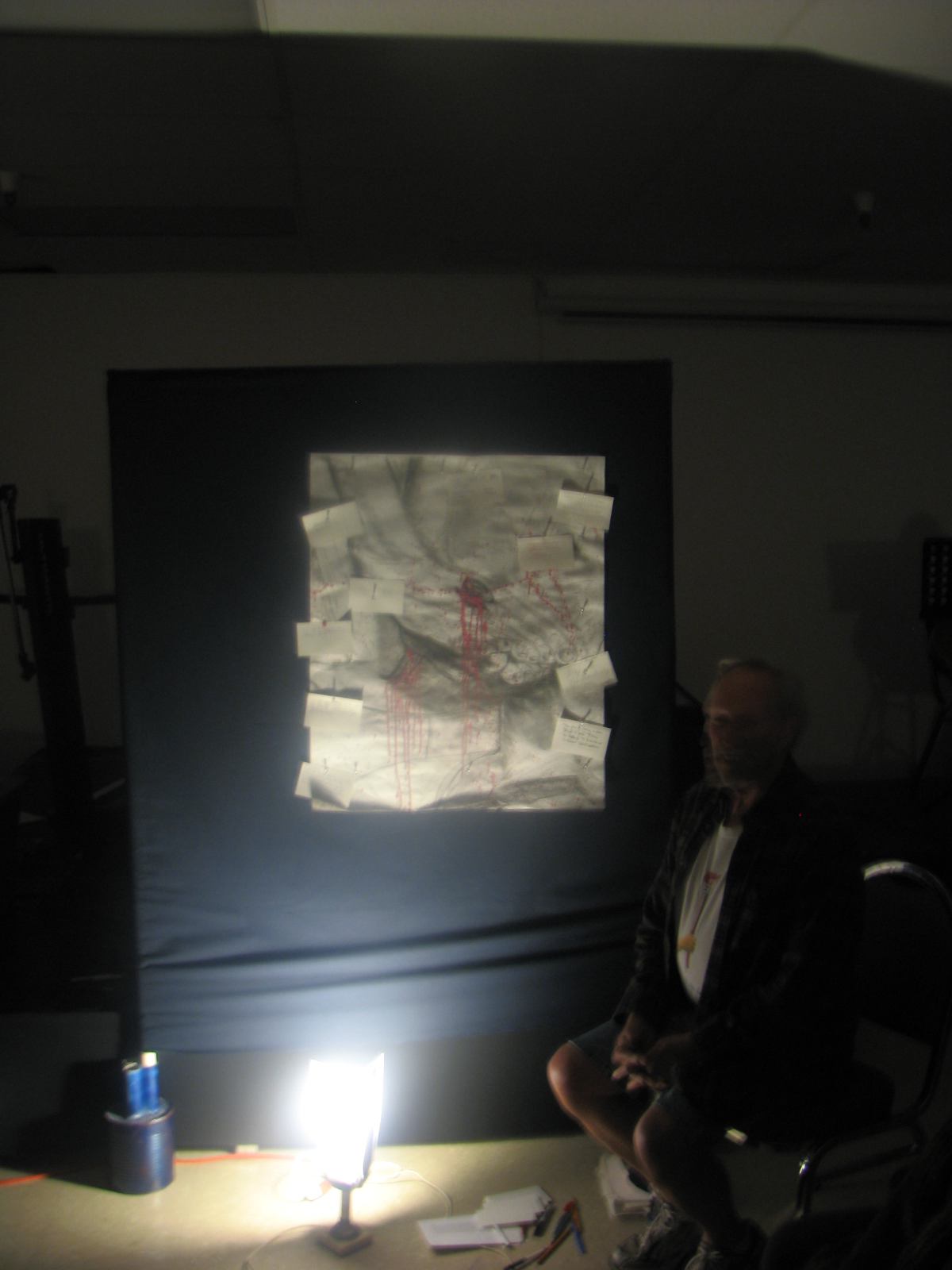
 Our ambient lighting is fluorescent (yuck!), so those lights were off. I put together makeshift stand lighting for musicians and speakers (the podium for speakers was between the communion table and the screen). The four images were pinned to black screens, lit by a small reading lamp on the floor, (I removed the shade and taped a piece of paper around half of it, letting the light shine onto the screen).
To set the context related to the suffering of Jesus, we heard readings: Matthew 26:36-38, John 13:1, 1 John 3:16, and Isaiah 53:4-6, with visuals on screen.
Then I gave this reflection/invitation: "Jesus suffers for our sake; he takes on the suffering that we have caused, and endures the suffering that we endure. Why? Because of his great love for us. The Bible tells us that he went to the cross for us not because we are worthy of it, not because anyone else would say we are worth dying for. But Jesus does. Jesus’ life tells us that God thinks that our salvation is worth dying for.
Tonight, we will look at four ways that Jesus has born the burden of the sins of the world through his suffering. And then we will be invited to follow in his footsteps, laying our burdens on him as he carries them to the cross. Listen to the story..."
Following this, we heard selecting readings from the Gospels related to four ways Jesus experienced suffering: Betrayal (Matthew 26:37-40), Abandonment (Mark 14:66-72), Humiliation (Mark 14:65, 15:16-20) and Injustice (Luke 23:13-25)
Next, we sang "O Sacred Head" (to a new tune I wrote.)
Then I shared a brief reflection about what Jesus accomplishes on the cross for us, why suffering is the way Jesus shows his love, and how his suffering and death are an invitation to lay our burdens at his feet, so that we would not have to carry them.
Then I invited people to go to one of the stations, respond according to the instructions, and then come to the communion table. Here are what the four stations looked like. Four volunteers from the congregation read short explanation of the station, and invited people to respond:
 Betrayal - In the paper hands that are holding Jesus' arm on the cross on this poster, write the names (or initials) of friends (or relatives, or other people) who have betrayed, abandoned or failed you. Or, write the names of friends, family, or other relationships that you have hurt, betrayed, or abandoned.
 Humiliation - Around the picture of the crown of thorns, write something that signifies your own humiliation. Perhaps it is the worst insult someone has ever called you, or the cruelest barb someone has thrown your way. Perhaps it is the most embarrassing moment you suffered. Or write something that signifies the worst name you have ever called someone, or a time when you tried to take someone's dignity from them. Jesus' death has paid the price for that guilt, too. Even if the exact words or situation are too personal to write down fully, try to think of initials, a single word, or a simple picture that would be make sense to you.
 Injustice - On the sign above Jesus' head, the Romans wrote the accusation against him: Jesus of Nazareth, the King of the Jews (In Latin, the first letters of each word spell "I.N.R.I."). On this poster of the sign, write the accusations and injustices you have carried with you. Perhaps they are instances you have been cheated or falsely accused. Perhaps they are injustices in the world you have witnessed or have grabbed your heart. Perhaps they are times when you have had the power to make things right, but have acted in your own interests and have not done so. Perhaps they are ways you have cheated others. Even if these things are too personal to write clearly, think of a single word, or of initials, that would represent this burden you carry.
 Pain - Jesus sufferers pain and wounds; his body is broken for us, so that when we suffer in our bodies, we can know that he has endured this and that his love is greater. Take an index card and write about the pain, disease, and suffering that you or a loved one has endured. Take a push-pin and stick these somewhere on the image.
The above instructions are excerpts--each group leader was given a few paragraphs to read that summarize the way Jesus suffered, and each instruction ends with a reminder that Jesus is the Lamb of God who takes away the sin of the world; these burdens we have carried can be put to death with him, so that we are freed from them.
After about 15 minutes of open ended time, as people began to take communion, we sang Kathryn Scott's song "At the foot of the cross." Then I wrapped it up with a few parting words. This was the only time I spoke off the cuff, but I said something like this:
"When the disciples left the cross that day, they were full of confusion, sadness, shock. And so we're going to leave tonight remembering that sorrow that Christ took on himself, and leave quietly. But we don't leave without hope. We know what Jesus' death means. Look around. Look at the burdens he has taken from us, that he has suffered for us on our behalf. You don't have to carry them any more. So Go in Peace."
I think what made this really special for me is that even though I had been planning this for months, and had scripted out almost all of it, I was still able to participate myself, to engage in these acts of worship on a very personal level, not just stand and observe or direct from a distance. Seeing people literally giving their burdens to Jesus was very moving.
Layout
.png)
Visual Environment
The Gathering
Here is the "Order of Service." (Four people rotated through the different scripture readings.) We began with a song familiar to our church, Chris Tomlin's riff on When I Survey (The Wonderful Cross). After that, our pastor opened with a prayer, and I followed with a short introduction, encouraging people to listen, watch, and meditate.To set the context related to the suffering of Jesus, we heard readings: Matthew 26:36-38, John 13:1, 1 John 3:16, and Isaiah 53:4-6, with visuals on screen.
Then I gave this reflection/invitation: "Jesus suffers for our sake; he takes on the suffering that we have caused, and endures the suffering that we endure. Why? Because of his great love for us. The Bible tells us that he went to the cross for us not because we are worthy of it, not because anyone else would say we are worth dying for. But Jesus does. Jesus’ life tells us that God thinks that our salvation is worth dying for.
Tonight, we will look at four ways that Jesus has born the burden of the sins of the world through his suffering. And then we will be invited to follow in his footsteps, laying our burdens on him as he carries them to the cross. Listen to the story..."
Following this, we heard selecting readings from the Gospels related to four ways Jesus experienced suffering: Betrayal (Matthew 26:37-40), Abandonment (Mark 14:66-72), Humiliation (Mark 14:65, 15:16-20) and Injustice (Luke 23:13-25)
Then I shared a brief reflection about what Jesus accomplishes on the cross for us, why suffering is the way Jesus shows his love, and how his suffering and death are an invitation to lay our burdens at his feet, so that we would not have to carry them.
Then I invited people to go to one of the stations, respond according to the instructions, and then come to the communion table. Here are what the four stations looked like. Four volunteers from the congregation read short explanation of the station, and invited people to respond:

 Humiliation - Around the picture of the crown of thorns, write something that signifies your own humiliation. Perhaps it is the worst insult someone has ever called you, or the cruelest barb someone has thrown your way. Perhaps it is the most embarrassing moment you suffered. Or write something that signifies the worst name you have ever called someone, or a time when you tried to take someone's dignity from them. Jesus' death has paid the price for that guilt, too. Even if the exact words or situation are too personal to write down fully, try to think of initials, a single word, or a simple picture that would be make sense to you.

The above instructions are excerpts--each group leader was given a few paragraphs to read that summarize the way Jesus suffered, and each instruction ends with a reminder that Jesus is the Lamb of God who takes away the sin of the world; these burdens we have carried can be put to death with him, so that we are freed from them.
After about 15 minutes of open ended time, as people began to take communion, we sang Kathryn Scott's song "At the foot of the cross." Then I wrapped it up with a few parting words. This was the only time I spoke off the cuff, but I said something like this:
"When the disciples left the cross that day, they were full of confusion, sadness, shock. And so we're going to leave tonight remembering that sorrow that Christ took on himself, and leave quietly. But we don't leave without hope. We know what Jesus' death means. Look around. Look at the burdens he has taken from us, that he has suffered for us on our behalf. You don't have to carry them any more. So Go in Peace."
I think what made this really special for me is that even though I had been planning this for months, and had scripted out almost all of it, I was still able to participate myself, to engage in these acts of worship on a very personal level, not just stand and observe or direct from a distance. Seeing people literally giving their burdens to Jesus was very moving.
Subscribe to:
Posts (Atom)